Water Flow in Porous Media
The apparatus consists of a cylinder of cross-sectional area A that is filled with a porous medium, such as sand. Water is slowly introduced into the left container and flows through the sand-filled cylinder until the pores are completely saturated.
As water continues to enter, the water levels in both containers gradually rise until the water in the right container reaches the top edge and begins to overflow. At that point, although water continues to enter from the left side, the right level remains constant. The left level continues to rise until the inflow rate Qin equals the outflow rate Qout.
At that moment, a steady-state flow condition is reached, where the amount of water entering equals the amount leaving. The value of Q represents the volumetric flow rate of water through the cylinder (i.e., volume per unit time, such as m³/s, L/s, or gal/min).
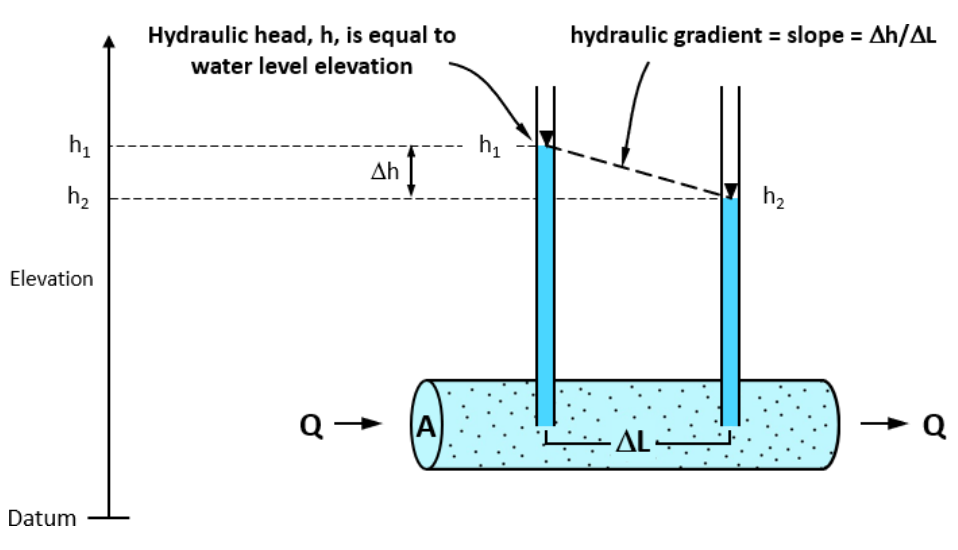
In this experiment, water flows from an area of higher hydraulic energy toward one of lower energy. This energy difference is called the hydraulic gradient, and can be expressed by the relationship:
i = ∆h / ∆L
where Δh is the hydraulic head difference between the two points, and ΔL is the distance between the piezometers. Flow is parallel to the cylinder axis and depends on the properties of the medium (porosity and hydraulic conductivity).
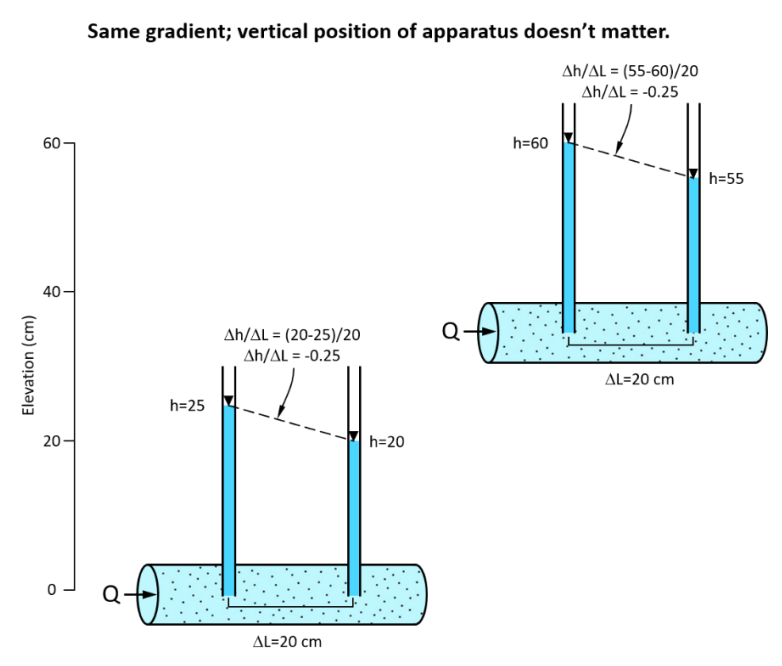
Under natural conditions, groundwater flow develops within a much more complex three-dimensional medium. Hydraulic gradients and flow directions can vary in both magnitude and direction depending on subsurface structure, the presence of confining layers, and terrain heterogeneity.
If we install wells to measure the hydraulic gradient without knowing the orientation of the stratum or the inclination of the medium, we can only deduce that there is a horizontal flow component. However, the flow could also have a vertical component (upward or downward) depending on the inclination of the medium or the arrangement of confining boundaries.
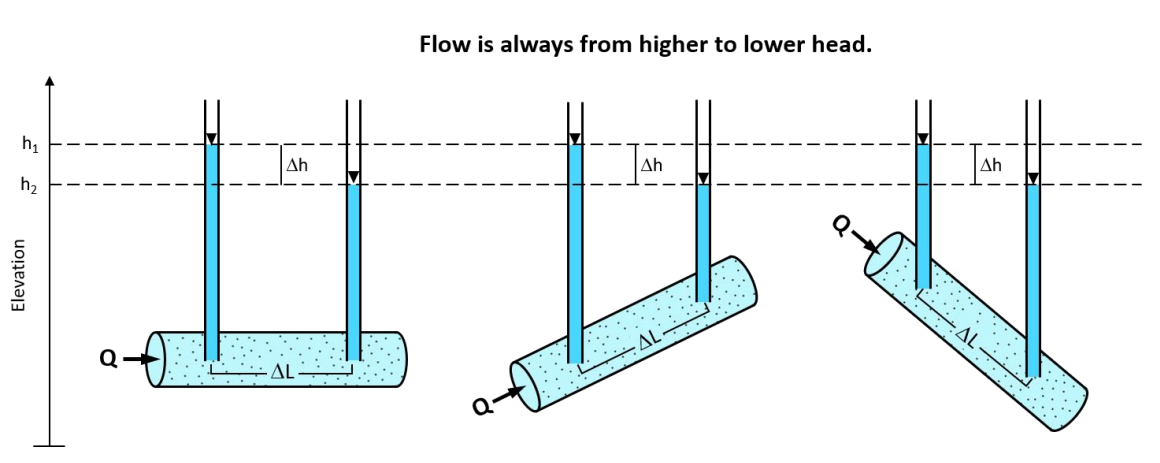
In some cases, the inclination may be so pronounced that flow approaches a vertical direction. This analysis underscores the importance of knowing the orientation of confining boundaries and other geological features to correctly interpret hydraulic head data and determine the actual flow direction.